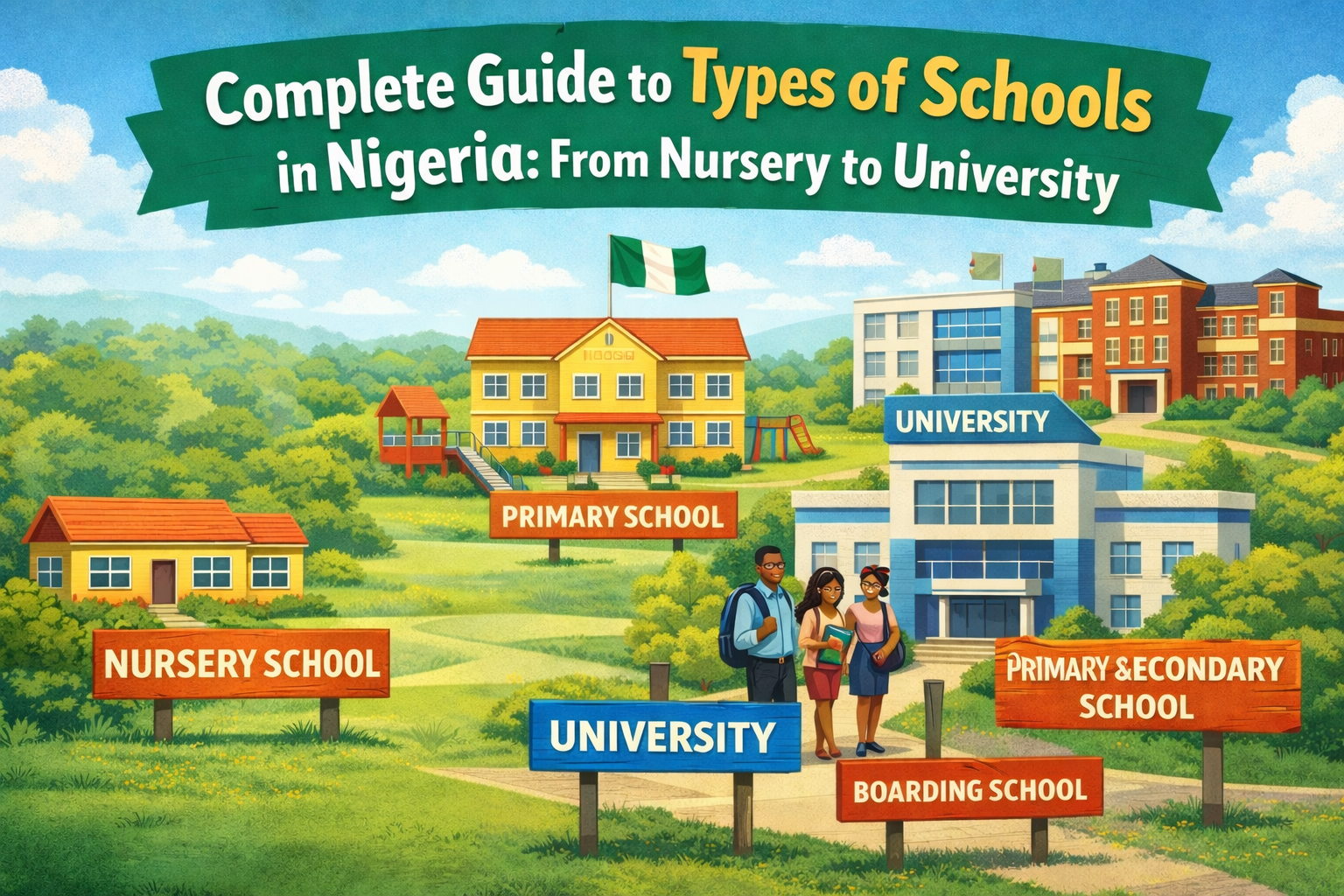
If you are a parent, student, or school owner in Nigeria, the education system can feel confusing.
Creche, nursery, primary, JSS, SSS, technical college, university, polytechnic, college of education… So many names. So many options.
This guide breaks everything down in simple language.
You will learn:
- The main types of schools in Nigeria (from early years to university)
- The age range and duration for each level
- The certificates and exams involved
- The various types of schools (public, private, mission-based, international, technical, etc.)
- What to look out for when choosing a school
Use this as your roadmap when browsing schools on NaijaSchools.com.ng.
Overview: How the Nigerian Education System Is Structured
Nigeria’s education system is usually described as 6-3-3-4 or 9-3-4, depending on how you group it:
- 6 years of primary school
- 3 years of junior secondary (JSS 1–3)
- 3 years of senior secondary (SS 1–3)
- 4+ years of tertiary education (university, polytechnic, college of education, etc.)
In practice, most children also pass through early childhood education (creche, nursery, pre-school) before primary.
So for our guide, we will group Nigerian schools into:
- Early Childhood Schools – Creche, Daycare, Nursery, Pre-school
- Primary Schools
- Junior Secondary Schools (JSS)
- Senior Secondary Schools (SSS)
- Technical & Vocational Schools
- Tertiary Institutions – Universities, Polytechnics, Colleges of Education, Others
- Special Categories – International schools, Unity schools, Special needs schools, Adult education, Tutorial centres
Let’s go level by level.
1. Early Childhood Schools in Nigeria
This is where most children start.
1.1 Creche and Daycare
Age range: 3 months – 3 years
Main purpose: Care, safety, basic socialization while parents work.
- Often attached to nursery/primary schools.
- Focus is on feeding, sleeping, play, and basic routines.
- Not strictly formal “education”, but good ones introduce songs, colours, shapes, and language.
What to check before choosing:
- Clean, safe environment.
- Trained caregivers (not just “any aunty”).
- Clear policies on feeding, sickness, security, and pick-up.
1.2 Nursery / Pre-School
Age range: 3 – 5 years
Duration: Usually 2–3 years (Nursery 1, Nursery 2, sometimes KG/Reception).
Focus:
Early literacy (letters, phonics, sounds)
Number recognition and counting
Colours, shapes, and basic science
Rhymes, stories, and play-based learning
Social skills: sharing, waiting, listening
You will see labels like:
- Nursery & Primary School
- Montessori School
- Pre-School
Montessori is a method that emphasizes hands-on learning and independence. Many schools use the word but don’t fully follow the method so always ask how they teach, not just what they call themselves.
What to check:
- Teacher-to-child ratio (small classes are better).
- Warm, patient teachers.
- Plenty of learning materials: books, puzzles, blocks.
- Safe outdoor play area.
2. Primary Schools in Nigeria
Age range: 6 – 11+ years
Duration: 6 years (Primary 1–6).
Primary school forms the foundation of basic education.
2.1 What pupils learn
Typical subjects include:
- English Language
- Mathematics
- Basic Science / Basic Technology
- Social Studies
- Civic Education
- One Nigerian language (e.g. Hausa, Igbo, Yoruba)
- Religious Studies (CRK/IRK)
- Physical & Health Education
- Computer Studies (in better-resourced schools)
2.2 Types of Primary Schools
Public (Government) Primary Schools
- Run by the state or local government.
- Often cheaper or free, but quality varies widely by location.
Private Primary Schools
- Run by individuals or organizations.
- Usually, smaller classes, more subjects, and extra-curricular activities.
- Fees range from very affordable to extremely expensive.
Faith-Based / Mission Schools
- Run by churches or religious bodies.
- Strong emphasis on morals and religious instruction.
International Primary Schools
- Often follow British, American, or mixed curriculum.
- Typically high fees, strong focus on global exposure.
Key exam:
Some pupils write the Common Entrance to get into Federal or top secondary schools.
What to check when choosing a primary school:
- Class size (ideally not more than 25–30 per class).
- Quality and stability of teachers.
- Reading culture (do they actually make children read?).
- Discipline style (shouting and flogging vs structured rules).
- Feedback to parents (reports, open days, communication).
3. Junior Secondary Schools (JSS) in Nigeria
Age range: ~12 – 14/15 years
Duration: 3 years (JSS 1–3).
Part of Basic Education (9 years: 6 primary + 3 junior secondary)
3.1 What students learn
Subjects broaden to include:
- English, Mathematics
- Basic Science, Basic Technology
- Social Studies, Civic Education
- Agricultural Science
- Business Studies
- Computer Studies / ICT
- Creative Arts, Music
- Physical & Health Education
- Introductory vocational/technical subjects (depending on the school)
At the end of JSS 3, students usually write the Basic Education Certificate Examination (BECE) (state or national), which determines progression into Senior Secondary or Technical/Vocational tracks.
3.2 Types of Junior Secondary Schools
- Public Junior Secondary Schools – Government-owned.
- Private Secondary Schools – Often combine JSS and SSS.
- Unity Schools (Federal Government Colleges) – Highly competitive, government-owned schools meant to promote national unity.
4. Senior Secondary Schools (SSS) in Nigeria
Age range: ~15 – 17/18 years
Duration: 3 years (SS 1–3).
Here, students start to specialize.
4.1 Academic Pathways
Senior secondary schools in Nigeria usually offer combinations of:
- Science – Physics, Chemistry, Biology, Further Maths, etc.
- Arts / Humanities – Literature, Government, History, CRS/IRS, etc.
- Commercial – Accounting, Commerce, Economics, etc.
- Sometimes, Technical / Vocational subjects.
4.2 Main Exams
At the end of SS3, students typically sit for:
- WAEC (WASSCE) – West African Examinations Council
- NECO (SSCE) – National Examinations Council
- Often JAMB UTME for university admission.
These results determine entry into universities, polytechnics, colleges of education, and other tertiary institutions.
4.3 Types of Secondary Schools
Public Secondary Schools
- State-run or federal (including Unity Schools like FGCs and FGC Girls’ Colleges).
Private Secondary Schools
Range from low-cost to “elite” schools with international exposure.
Faith-Based / Mission Secondary Schools
- Popular for their discipline and moral training.
International Secondary Schools
- Offer IGCSE, SAT, A-Levels alongside WAEC/NECO.
What to check before choosing a secondary school:
- WAEC/NECO performance (not just what they claim – ask for proof).
- Quality of science labs if your child wants sciences.
- Guidance and counselling support.
- Boarding facilities (if boarding).
- Bullying and discipline policy.
5. Technical & Vocational Schools
Nigeria’s policies recognize the need for job-oriented education, especially for students who are more practical or skill-driven.
5.1 Technical Colleges & Vocational Secondary Schools
These schools:
Focus on trades and technical skills, such as:
- Electrical installation
- Carpentry & joinery
- Welding & fabrication
- Motor vehicle mechanics
- Computer maintenance
- Fashion design, catering, etc.
May admit students after JSS 3 or SS3, depending on the structure.
Students often work towards trade test certificates, NABTEB, or similar credentials, which can lead to:
- Direct employment
- Apprenticeship
- Further study in polytechnics or technical institutes
5.2 Why they matter
Not every student needs or wants a traditional academic path.
If a child is:
- Hands-on
- Not interested in long theory
- Good with tools, creativity, or practical work
…then a good technical or vocational school may serve them better than forcing them into a strictly academic path where they will struggle.
6. Tertiary Institutions in Nigeria
After senior secondary (SS3) and the relevant exams (WAEC/NECO/JAMB), students move into tertiary education.
This sector includes:
- Universities
- Polytechnics & Monotechnics
- Colleges of Education
- Specialized Institutions (Schools of Nursing, Health Tech, Agriculture, etc.)
6.1 Universities
Duration: 4–6+ years, depending on the course.
Types:
- Federal Universities – Owned by the Federal Government.
- State Universities – Owned by state governments.
- Private Universities – Owned by private individuals, organizations, and religious bodies.
Degrees awarded:
- Bachelor’s (B.A, B.Sc, B.Eng, LL.B, MBBS, etc.)
- Later: PGD, Master’s, PhD.
Universities in Nigeria are regulated by the National Universities Commission (NUC).
6.2 Polytechnics & Monotechnics
Duration:
- ND (National Diploma): 2 years
- HND (Higher National Diploma): Additional 2 years after ND + industrial training.
Focus:
- More practical and technical than universities.
- Courses in engineering, technology, applied sciences, business, etc.
Regulated by agencies like the National Board for Technical Education (NBTE).
6.3 Colleges of Education
Duration: Typically 3 years for NCE (Nigeria Certificate in Education).
Focus:
- Training teachers for primary and junior secondary schools.
- Emphasis on pedagogy (how to teach) as well as subject knowledge.
Regulated by the National Commission for Colleges of Education (NCCE).
6.4 Other Tertiary-Level Institutions
These include:
- Schools of Nursing & Midwifery
- Schools of Health Technology
- Agricultural Colleges
- Specialist institutes (e.g. maritime, aviation, etc.)
They often award professional diplomas, licenses, and certificates needed for practice.
7. Special Categories of Schools in Nigeria
Beyond the main structure, there are other important categories.
7.1 Public vs Private Schools
Across all levels (nursery to tertiary), schools are either:
- Public (Government) – Federal, state, or local government. Often cheaper, but quality varies.
- Private – Owned by individuals, companies, or missions. Often smaller classes and more facilities, but higher fees.
7.2 Unity Schools (Federal Government Colleges)
Unity schools are federal secondary schools created to:
- Promote national unity by bringing together students from different states.
- Provide relatively high-quality education.
They are very competitive, with entrance exams from primary school.
7.3 International Schools
Usually located in big cities (Lagos, Abuja, Port Harcourt, etc.) and:
- Follow British, American, or mixed curricula.
- Prepare students for exams like IGCSE, SAT, A-Levels, in addition to local ones.
They are popular with:
- Expatriates
- Nigerians who may want their children to study abroad
- Parents who can afford high fees
7.4 Special Needs Schools
These schools support children with:
- Hearing impairment
- Visual impairment
- Autism
- Learning difficulties
- Physical disabilities
Some are standalone special schools; others are regular schools with inclusive units.
If your child has special needs, look for:
- Trained special educators.
- Accessible facilities.
- Individualized learning support.
7.5 Adult Education & Non-Formal Schools
For adults and out-of-school youths:
- Adult literacy centres
- Evening classes
- Non-formal education programmes
These help people:
- Learn to read and write.
- Prepare for exams like WAEC, NECO as private candidates.
7.6 Tutorial Centres & Exam Prep Schools
Not formal schools, but very common:
- JAMB/WAEC/NECO tutorial centres
- A-level/SAT prep centres
They support students who:
- Need extra coaching
- Are rewriting exams
- Want intensive preparation
Quality varies a lot, so always check the track record and teaching style.
How NaijaSchools.com.ng Fits Into All This
With so many types of schools in Nigeria, it’s easy to feel lost.
That is why a directory like NaijaSchools.com.ng is useful:
- You can search by level – nursery, primary, secondary, university, polytechnic, college of education, school of nursing, etc.
- Filter by location – state, city, area.
- See basic details like address, contact, website, and sometimes reviews.
- Compare options when you are relocating, changing schools, or planning tertiary admission.
Instead of guessing, you can start with verified information in one place, then visit or call schools that match your needs.
Conclusion
Nigeria’s school landscape is big, messy, and diverse, but it is not impossible to understand.
In summary:
- Early years: Creche, nursery, pre-school.
- Basic education: 6 years primary + 3 years junior secondary.
- Senior secondary: 3 years, leading to WAEC/NECO and JAMB.
- Tertiary: Universities, polytechnics, colleges of education, and specialized schools.
- Special categories: Technical/vocational, unity schools, international schools, special needs, adult education, tutorial centres.
Once you understand what each type of school does, you can make better decisions for:
- Your child’s education
- Your own study or career path
- Your school’s positioning (if you’re a school owner)
Next Step
If you are:
- A parent looking for the right school
- A student planning your next level
- Or a school owner who wants more visibility
Start by browsing schools on NaijaSchools.com.ng and shortlist the ones that match your level, location, and goals. Then visit them, ask questions, and choose with your eyes open.