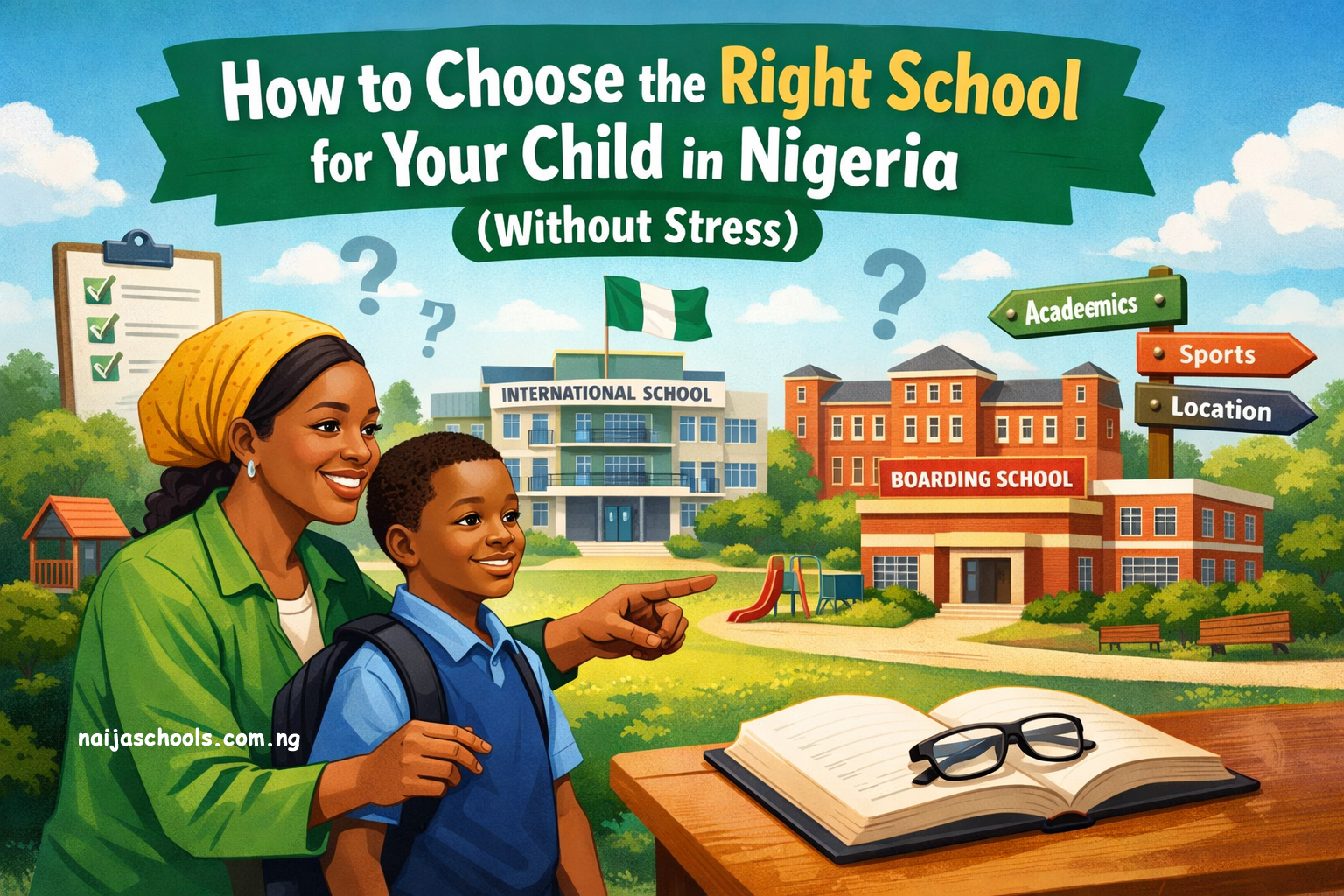
How to Choose the Right School for Your Child in Nigeria (Without Stress)
Choosing a school for your child in Nigeria can feel like war.
Too many options. Too many opinions. Fees everywhere. And still you are not sure if the school is actually good.
This guide will walk you through, step by step, how to pick a school with confidence, whether it is nursery, primary, secondary, or higher institution, and how a school directory like Naijaschools.com.ng can make the whole process easier.
Start With Your Child, Not the School
Most parents start by asking:
“Which school is the best in my area?”
Wrong question.
First question should be:
“What kind of child am I raising, and what do they need?”
Ask yourself:
Is my child very social or quiet?
Do they learn better by doing or by listening?
Do they struggle with any subject and need extra support?
Do I prefer a very strict, moderately strict, or more relaxed environment?
Do I want a strong religious/moral emphasis?
Write this down on paper. It becomes your filter.
A “top” school that doesn’t fit your child is a bad school for you.
Decide Your Non-Negotiables
Before you start visiting websites and talking to proprietors, decide what is non-negotiable for you.
Examples of non-negotiables:
Location
Maximum travel time: e.g., not more than 30–45 minutes from home.
Main road only? Estate only? School bus required?
Type of school
Day school or boarding?
Mixed or single-sex?
Private / Mission / Government?
Budget range
Termly school fees range (e.g. ₦100k–₦250k / term).
Can you handle other charges – uniform, books, PTA levy, lab fees, exam levies?
Curriculum
Nigerian curriculum only (WAEC/NECO)?
Nigerian + British (IGCSE)?
Montessori for early years?
Write your non-negotiables on the same sheet. Anything that doesn’t match this list is out.
Shortlist Schools the Smart Way
This is where most parents waste time asking random people, jumping from one Facebook group to another, or driving around to “just see schools.”
Use a directory first.
How a school directory helps
A platform like Naijaschools.com.ng lets you:
Search by location – state, city, or area.
Filter by school type – nursery, primary, secondary, university, polytechnic, college of education, school of nursing, etc.
Check basic details at a glance – address, contact information, website, and social media.
Sometimes see reviews, photos, and programs offered.
Instead of starting from 100+ schools, you can narrow down to maybe 5–10 serious options in minutes.
Check the Basics Before You Visit
Before you start moving around, do this quick background check online:
Website and Online Presence
Look at:
Website
Is there a real website linked from the directory (e.g., on Naijaschools.com.ng)?
Does it show real photos or just stock images?
Is there clear information on the curriculum, fees range, and activities?
Social media
Facebook, Instagram, etc
Recent posts? Or last update was 2019?
Do you see real students, events, and classroom activities?
A school that wants to be taken seriously in 2025 should not be invisible online.
Accreditation and Approvals
For higher institutions (universities, polytechnics, colleges of education, and schools of nursing):
Confirm they are approved/accredited by the relevant bodies (e.g., NUC for universities, NBTE for polytechnics, etc.).
Many school directories will show this status or link to official pages. If not, search the school name on the regulator’s site.
For basic and secondary schools, check if they are registered with the state Ministry of Education.
Visit the School: What to Look For (With Your Eyes, Not Their Brochure)
Now you can book visits with your top 3–5 schools. Don’t just sit in the office and listen to sweet talk. Walk around. Use your eyes.
Environment and Safety
Look for:
Is the compound clean or dusty and dirty?
Are the classrooms well-ventilated?
Is there fencing and a gate? Any security personnel?
Are there fire extinguishers or basic emergency tools visible?
Are the toilets usable, especially for younger children?
If the toilet is a mess, believe me, everything else is likely disorganized too.
Class Size
Ask plainly:
How many students are in one class?
How many teachers per class?
Ideal:
Lower classes: 15–25 pupils per teacher.
Secondary: 20–30 per class is manageable.
If they are squeezing 45–60children in one small room, your child will likely disappear in that crowd.
Teacher Quality
Ask:
What qualifications do most teachers have? (NCE, B.Ed., B.Sc., PGDE, MSc, PhD?)
Do they receive regular training?
How long has the average teacher been in the school?
Watch for:
Do teachers look engaged and friendly, or tired and frustrated?
Are they shouting all the time, or speaking respectfully?
One good teacher is better than a fancy building with poor teaching.
Ask the Right Questions (Don’t Be Shy)
When you meet the proprietor or school administrator, here are the questions you should ask:
1. What makes your school different from others in this area?
If they can’t answer clearly, they don’t know what they’re doing.
2. How do you handle children who are struggling academically?
Extra lessons? One-on-one support? Or do they just complain?
3. How do you handle discipline?
Is it all beating and shouting? Or do they use clear rules, consequences, and guidance?
4. What is your policy on bullying?
What happens if a child is bullied? How can parents report it?
5. Which exams do your students normally write, and how do they perform?
For secondary: WAEC, NECO, JAMB, IGCSE.
For higher institutions: professional exams, licenses, etc.
Write down the answers. You’ll need them when comparing schools later.
Look Beyond Academics: What Else Will Your Child Learn Here?
Yes, you want your child to pass exams. But life is more than certificates.
Check for:
Clubs and societies – Literary & Debate, Press Club, ICT club, JETS, Drama, Music, Entrepreneurship, etc.
Sports – football, volleyball, athletics, table tennis, etc.
Life skills – coding, public speaking, leadership, financial literacy, home management, etc.
Character and values – integrity, respect, responsibility, empathy.
Ask:
What kind of person do you hope your students become after passing through this school?
Their answer will tell you their real priority.
Compare Schools Side by Side
After your visits, sit down (ideally with your spouse/partner) and compare your top schools.
You can create a simple table like this:
Factor
School A
School B
School C
Distance from home
20 mins
40 mins
15 mins
Fees / term
₦200k
₦100k
₦250k
Class size
25
35
18
Facilities
Good
Average
Excellent
Teacher quality
Good
Poor
Very good
Extra activities
Few
Many
Many
General “feel”
7/10
5/10
9/10
Rate each school on a scale of 1–10 on the things that matter most to you:
Distance
Fees
Class size
Teacher quality
Discipline
Safety
Activities
Your gut feeling
You will quickly see which one stands out.
Involve Your Child (But Don’t Let Them Choose Alone)
If your child is old enough (especially for secondary and higher institutions), let them:
Visit with you.
Walk around the compound.
See the classrooms.
Maybe even sit in a class for a few minutes (if allowed).
Ask them quietly:
How did you feel in this school? Can you see yourself learning here?
But remember: you are the adult. They may choose a school just because of the football pitch or the school bag. Listen to them, but don’t surrender your judgment.
Red Flags You Should Not Ignore
No matter how cheap or “prestigious” a school looks, walk away if you see:
Dirty, smelling toilets with no plan to fix them.
Extremely crowded classes.
Teachers constantly shouting, insulting, or humiliating children.
No clear security or access control.
Zero transparency about fees (they cannot show any breakdown).
Bad attitude from management when you ask genuine questions.
Fake promises about 100% “guaranteed” exam success.
Your child is not an experiment. Don’t use them to test a clearly problematic school.
Use Directories to Keep Options Open
Life happens. You may need to:
Change schools because you are relocating.
Move your child from boarding to day school (or vice versa).
Find schools of nursing, polytechnics, or universities in another state.
Instead of starting from scratch every time, bookmark Naijaschools.com.ng (or your chosen directory) and use it as your starting point for:
Discovering schools in new locations.
Checking options for higher education.
Finding contact details quickly.
Comparing multiple schools in one place.
It saves time, fuel, and stress.
Conclusion: Choose With Peace, Not Panic
You won’t find a “perfect” school.
But you can find a good, safe, and serious school that fits:
Your child,
Your values,
Your budget.
Take it step by step:
Understand your child.
Decide your non-negotiables.
Use a directory like Naijaschools.com.ng to shortlist.
Visit and inspect the environment, teachers, and culture.
Ask the right questions.
Compare your options calmly.
When you have done all this, make your choice and rest. Then partner with the school: show up, follow up, and support your child.
Ready to start your school search?
Visit Naijaschools.com.ng to discover nursery, primary, secondary schools, universities, polytechnics, colleges of education, and schools of nursing across Nigeria all in one place.