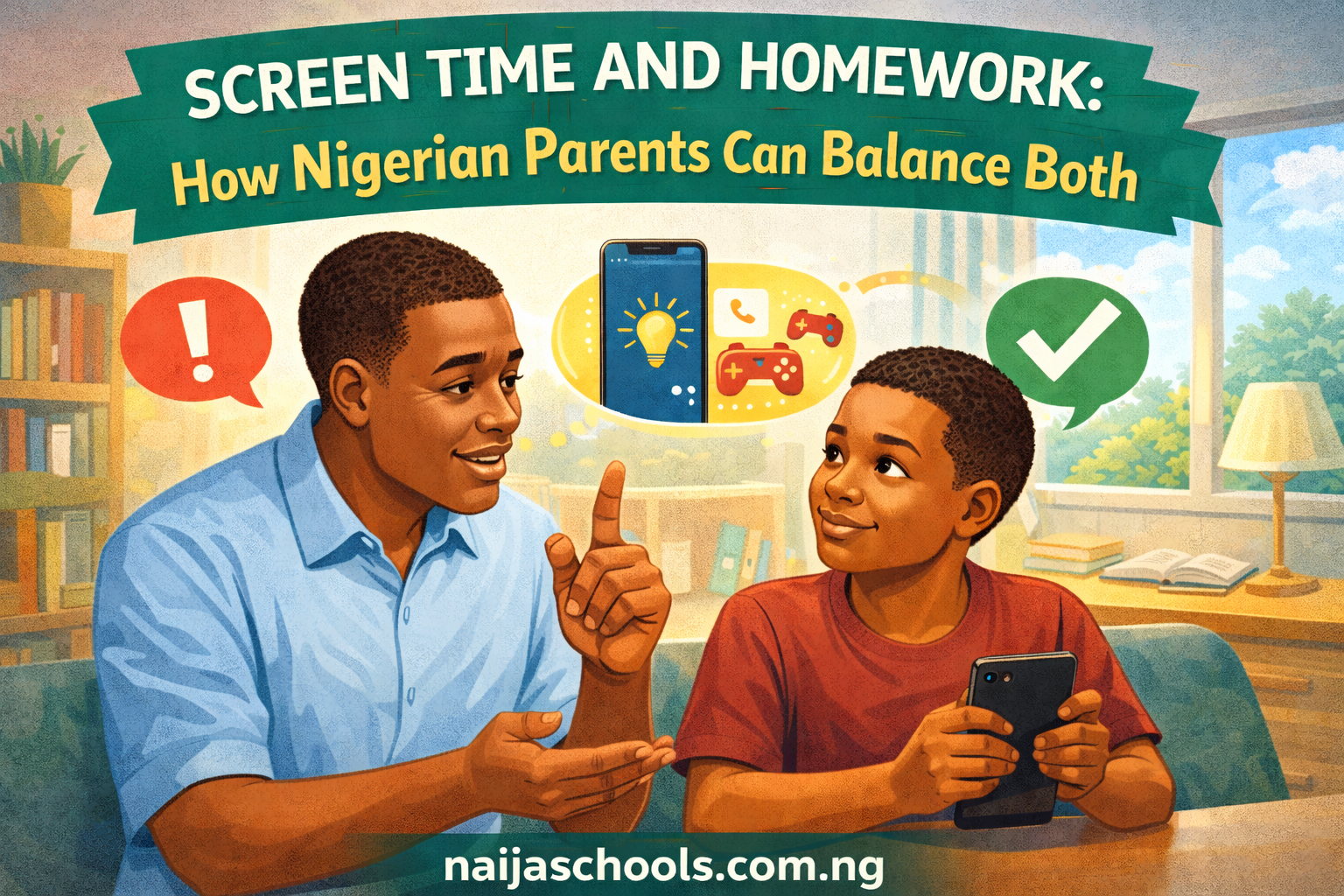
Let’s be honest: in many Nigerian homes today, this is the evening routine:
- The child comes back from school
- Drops bag
- Picks up phone/tablet/TV remote
- Hours later: “Have you done your homework?!” → shouting begins
Screens are not going away.
Phones, TVs, tablets, and laptops are part of modern life.
The real question is:
How can Nigerian parents balance screen time and homework without turning the house into a war zone?
That is what this guide will show you in simple, practical steps.
Why Screen Time Is a Big Issue Now
In the past, children went outside to play, read books, or help with chores after school.
Now:
- YouTube, TikTok, Instagram, and games are calling them.
- Many children spend hours on screens and minutes on homework.
- Parents are tired from work and sometimes use screens as “digital babysitters”.
Screens themselves are not evil.
The problem is too much, at the wrong time, with no control.
Your job is not to “kill” screen time.
Your job is to control it and use it wisely.
Step 1: Accept That Screens Are Here to Stay
If your strategy is:
No phone, no TV, no nothing!
…it will likely fail.
Why?
- Children will find other ways to access screens (friends’ houses, school, and cybercafés).
- They may start hiding things from you.
- You will miss the chance to teach self-control.
Better approach:
Screens are allowed, but with rules. Homework and learning come first.
You want your child to grow up knowing how to manage technology, not run away from it.
Step 2: Set Clear House Rules for Screen Time
Children need clear, simple rules. If not, they will push until you explode.
Sit down as a family and agree on basic rules like:
Example Screen Time Rules
- No screen time until homework is done.
- No screens during meals.
- Weekdays: maximum of 1–2 hours of leisure screen time.
- Weekends: more flexible, but still limited (e.g. 3–4 hours total, broken up).
- No phones or TV after a certain time at night (e.g. 9pm).
Write these rules and stick them on the wall or fridge.
Important:
- Rules must apply to everyone as much as possible.
If you are always on your phone, your “no screen” talk is useless.
Step 3: Create a Simple After-School Routine
Chaos breeds arguments.
A fixed after-school routine removes guesswork and fights.
Sample Weekday Routine for Nigerian Families
- 3:30–4:30 pm: Child gets home, eats, rests, maybe brief TV (30 mins).
- 4:30–6:00 pm: Homework and reading time.
- 6:00–7:00 pm: Chores, bath, help in the kitchen.
- 7:00–8:00 pm: Dinner + light screen time (TV/phone) if homework is done.
- 8:00–9:00 pm: Prepare for the next day, light reading, sleep.
You don’t have to copy this exactly.
Adjust based on:
- When your child gets home
- Your work schedule
- Power supply situation
The key is: homework has a fixed time every day, not “any time”.
Step 4: Separate Homework Time from Screen Time
Many children say:
I’m reading on my phone.
I’m just checking something on Google.
Next thing: they are on TikTok, Snapchat, or random videos.
Your job:
- For daily homework and revision, prefer:
- Exercise books
- Textbooks
- Printed notes
- Past question booklets
- If a screen is needed (e.g., research, online learning):
- Sit with them at intervals.
- Check what exactly they are doing.
- Use airplane mode or site blocks if necessary to prevent distraction.
If your child is doing homework with WhatsApp, Instagram, and TikTok open, they are not really studying; they are multitasking themselves into confusion.
Step 5: Turn Some Screen Time into Learning Time
Not all screen time is bad. Some of it can actually boost school performance.
Examples of productive screen use
- Watching educational videos on:
- Mathematics
- English grammar
- Science topics
- WAEC/NECO/JAMB preparation
- Using learning apps:
- Quiz apps
- JAMB CBT practice apps
- Vocabulary builders
- Researching school topics:
- Causes of erosion
- Photosynthesis explained for kids
How to write an informal letter
How to do this without losing control
- Create a small list of approved channels/apps.
- Allow them during study blocks, not leisure time.
- Example rule:
From 5 pm–6 pm, you can use the phone for learning only. After that, any leisure screen time must stay within your daily limit.
You are flipping the game:
Screens become allies for learning, not just enemies.
Step 6: Be Consistent with Consequences
Rules without consequences = jokes.
If the rule is:
No screen time until homework is done.
…then you must enforce it.
Simple consequence structure
- If child follows rules →
- They get their agreed screen time.
- Plus maybe extra 15 minutes on weekends.
- If child breaks rules (e.g. sneaks phone, lies about homework) →
- Lose screen time the next day.
- Calm discussion about why the rule exists.
No screaming every day. Just consistent follow-through.
Children test boundaries. Once they see you mean what you say, they adjust.
Step 7: Know Your Child’s Weak Points
Not all children are tempted by the same things.
- Some are addicted to TV series and cartoons
- Some are stuck on video games
- Others can’t leave TikTok, Instagram, or WhatsApp
Pay attention:
- What eats most of their time?
- When do they secretly use the phone?
- Which apps cause the biggest distraction?
Once you know:
- Set specific limits around those apps/channels.
- You can:
- Remove certain apps temporarily.
- Change passwords on TV decoders.
- Keep game consoles in your room when not in use.
Don’t just say “Stop screen”.
Say:
This particular thing is your problem. We are going to reduce/control it.
Step 8: Lead by Example (This One Hurts)
If you are honest, you will realise:
- Many parents are also addicted to their phones.
- Children watch you scrolling endlessly and copy you.
You can’t shout:
Stop pressing the phone!
…while your own eyes are glued to WhatsApp, Facebook, X, Instagram, or Netflix all evening.
Try this:
- During homework time, also:
- Read a book
- Work on your laptop quietly
- Do something productive offline
- During meals:
Children copy what you do, not what you say.
Step 9: Protect Sleep No Late-Night Scrolling
Sleep is a serious factor in:
- Memory
- Attention
- Mood
- Exam performance
If your child sleeps late every night because of the phone or TV, don’t be surprised when:
- They can’t focus in class
- Homework takes too long
- They become cranky and lazy
Simple sleep rules
- No screens at least 30–60 minutes before sleep.
- Fix an age-appropriate bedtime (e.g. 9–10pm for most school-age children).
- Charge phones outside the bedroom if possible.
Tired brain = poor learning.
Well-rested brain = faster homework, better results.
Step 10: Talk With Your Child, Not At Them
If your approach is only:
- Shouting
- Threatening
- Comparing (“See your mate…”)
…your child will:
- Pretend to agree in front of you
- Disobey behind your back
Instead, have an honest conversation:
- How much time do you think is okay for screen time each day?
- How can we make sure your homework is done before you go online?
- What apps or games distract you the most?
You may be surprised: some children know they have a problem and want help.
Work as a team to design the rules.
When they’re involved, they’re more likely to cooperate.
What If My Child Needs a Phone for School?
Some schools and higher institutions require phones for:
- Research
- Online tests
- Class groups
- Assignments
In that case, don’t panic. Just tighten the system:
- Use data limits (e.g. small weekly data, not unlimited).
- Use app restrictions (block or limit social media during certain hours).
- Keep schoolwork periods and leisure periods separate.
- Review their usage weekly:
- Show me what you did online for school this week.
You are not trying to spy on every click.
You are just making sure academics are not being suffocated by nonsense.
How NaijaSchools.com.ng Fits In
Balancing screen time and homework is part of choosing the right overall learning environment.
On NaijaSchools.com.ng, parents can:
- Discover schools that:
- Take academics seriously
- Use technology properly (e-learning, computer labs, research)
- Communicate clearly with parents about homework and device use
- Compare schools by:
- Type (day/boarding, primary/secondary/higher)
- Location
- Culture and expectations
A school that understands the reality of digital life and works with parents can help your child build healthy screen habits, not just punish them.
Conclusion: Control the Screens, Don’t Let Screens Control You
To balance screen time and homework in a Nigerian home:
- Accept that screens are part of life.
- Set clear house rules and stick to them.
- Create a daily routine where homework has a fixed time.
- Separate homework time from entertainment time.
- Turn some screen time into learning time.
- Enforce consequences calmly and consistently.
- Lead by example with your own device habits.
- Protect your child’s sleep and mental health.
You don’t need to be perfect.
You just need to be intentional.
When you control the screens instead of letting them control your home, your child will:
- Finish homework faster
- Learn better
- Still enjoy technology without being swallowed by it
If you are serious about your child’s education:
- Use NaijaSchools.com.ng to find schools that match your values on discipline, technology, and academics.
- Then, at home, enforce healthy screen-time habits.
School + home + controlled screens = a child who can succeed in today’s digital world.